
TO: Airborne Employees
FROM: Gene Rhodes DATE: October 23, 2001
Corporate Director, Human Resources
SUBJECT: 2002 Health Care Changes
As an employee of Airborne Express you enjoy an excellent benefits package. Over the years Airborne has worked diligently to provide quality health care plans and preserve the high level of benefits you enjoy, while keeping your cost as low as possible.
Since 1993 Airborne has absorbed all increases in health care costs in the core company medical plan without passing any of these costs on to employees. Over this period of time, medical claims costs have been growing, especially in the past 4 years. While company-paid costs have been increasing, employees have not shared in paying any of these rising costs. Employee contributions have remained unchanged.
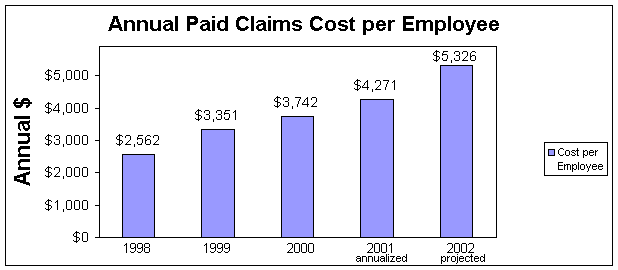
In 2002, Airborne’s health costs are projected to increase $14.5 million. The cost per covered employee is expected to reach $5,326 for medical claims in 2002. With the current economic conditions, these increases have exceeded what the company can support and Airborne must now share more of the cost with you, the employees.
Over the past several months I’ve shared with you some reasons for these increases. Some of the factors, but not all, include:
 | Prescription drug usage increased 27% per covered individual and overall prescription drug cost increased 53% | |
| Emergency Room visits have been more than doubled the norm, primarily attributable to inappropriate use for non-emergency care | |
| Newer and more expensive medical technologies have been introduced. |
Airborne is not alone in seeing these cost increases. A benefits survey conducted by the benefits consulting firm William M. Mercer, indicates that the average employee at large companies now pays $48 per month ($576/year) for single coverage and $184 per month ($2,208/year) for family coverage. According to a recent USA Today article (August 27, 2001), health care expenses are increasing 13% to 20% or more next year – the biggest in a decade. And next year’s increases do not take into account the impact of the Patient’s bill of rights, now before Congress. Most companies, including Airborne, are facing the reality of increasing the employee’s share of health care cost.
Given this set of conditions, the following changes are being made to the Airborne Express medical plans effective January 1, 2002.
| The Enhanced PPO plan will have higher co-payments for doctor visits, urgent care visits and prescriptions. In addition, a co-payment for emergency room visits is being introduced. Last, the employee contributions for the Enhanced PPO plan will be increasing. |
| Airborne is introducing a new plan called the "Basic PPO" for employees. This new option will have lower employee contributions and lower coverage levels than the Enhanced PPO plan. This plan may be attractive to employees who prefer a lower cost option that still provides catastrophic protection. |
| The Traditional Plan is being discontinued effective January 1, 2002. Employees enrolled in this option will need to select another medical plan for 2002. The decision to discontinue this plan is based on the low participation rate (249 employees) and the high cost of this plan. |
Airborne does not make this decision lightly. The Company has carefully reviewed various alternatives to minimize the impact on employees and their families. These are tough economic times requiring hard decisions that undoubtedly will not be popular.
Airborne health care costs are evaluated on a continual basis. If costs were to trend downwards then contribution and benefits levels would likewise be reconsidered. However I don’t want to give you false hope. The reality of the health care situation is this – we don’t anticipate health care costs will decline in the foreseeable future. The health industry experts are predicting double-digit growth percentages in health care costs every year over the next five years. But you can help control these costs.
The most effective tool for moderating future increases will be our prudent use of the health care system. We can all keep in mind that the PPO network does not require us to visit our family doctor to get a referral to a specialist. We can discuss the use of generic drugs with our doctors rather than asking for a brand name medication advertised on television. We can use mail order for recurring prescription drug refills. We can see the family doctor or visit an urgent care facility for non-emergency care.
Highlights of the medical plan changes are included on the attachment for your review. More detailed information will be provided with the annual open enrollment material scheduled to be distributed to employees the first week of November.
Thank you for your attention.
Copyright © 2005. ABX Air, Inc. All Rights Reserved.
Please see ABX Air, Inc.’s terms and conditions for use of this web site.