
TO: Airborne Employees May 3, 2001
FROM: Gene Rhodes
Corporate Director, Human Resources
SUBJECT: Prescription Drug Costs
This is the second in a series of memos discussing the rising cost of health care at Airborne Express. I received many responses to my earlier mailing, and we are looking at the cost-saving suggestions you gave me. Thank you for your interest in this important topic that affects all of us at Airborne. In this memo I would like to focus on an area that has seen an alarming rate of increase: prescription drugs.
The cost of providing prescription drug benefits continues to rise. Many employers have experienced drug expenses rising in excess of 50 percent over the past two years. Airborne alone experienced a 53% increase in 2000. Experts predict drug expenses will continue to rise approximately 19 percent a year over the next four years. Cost increases are due to many reasons, including:
 | New drugs and technology | |
| Drug price inflation | |
| Biotechnology | |
| Aging population | |
| Consumer demand fueled by direct-to-consumer advertising | |
| Physician behavior |
Many of these items are beyond the control of employees. However, you can help control some things. For example, people tend to request the drugs they have seen advertised. In a recent study a surprising 80% of the people reported that their physicians prescribed the drugs they specifically requested. Patients have a significant influence on physician behavior as physicians strive to meet their customers’ requests.
I would suggest that when your physician prescribes medication, don’t just ask for a drug you saw advertised for your condition. Discuss the options with your physician. Whenever possible use generic drugs. Generic drugs work just as well as brand name drugs and cost less for you and the health plan. When generics are not available, ask your physician to prescribe from the United Health Care Preferred Brand-Name Drug List. And if you are on maintenance drugs, use the mail order program to save money.
What is the Preferred Brand-Name Drug List?
United Health Care (UHC) maintains a list of preferred brand-name drugs. Many brand-name drugs are on this list, and it is updated quarterly by UHC’s national Pharmacy and Therapeutics Committee to ensure it meets your needs.
This list is comprehensive, covering all drug classes. To allow for flexibility and choice, UHC has included multiple brand-name medications within certain drug classes. However, not every brand name drug is on the list. By limiting the number of drugs available, UHC is able to negotiate discounts with the drug manufacturers to help control our cost and maximize your pharmacy benefit.
Your physician still can prescribe non-preferred brand-name drugs but these are generally more expensive to the health plan. Final decisions regarding treatment always are made by you and your physician. But whenever possible, I ask you to request a preferred brand-name drug when generic is not available.
UHC recently mailed out the preferred brand-name drug list to employees who have purchased brand name drugs. This list is also available on their web site at www.uhc.com or from your Benefits Department.
Are Generic Drugs Really the Same as Brand Name Drugs?
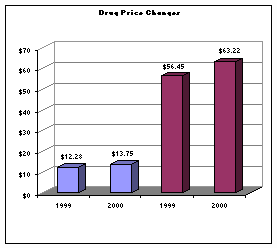
Yes, with one exception — they cost significantly less. Generic drugs must meet the same strict Food and Drug Administration (FDA) standards for purity, strength, and safety as brand name drugs. Generic drugs are made from the same chemical compounds and manufactured according to the same standards as brand name drugs. In fact, according to the FDA, brand name manufacturers account for approximately 75 percent of all generic drug production — many times actually manufacturing generic versions of their own companies’ brand name drugs. With brand name drugs costing up to 10 times as much as their generic equivalents, switching to a generic whenever possible maintains a high quality product and keeps costs down.
How Does the Mail Order Program Work?
If you are enrolled in the Enhanced PPO plan and are using a maintenance drug for the treatment of a chronic condition, I suggest you consider using the mail order program. Not only does the mail order program save our health plan money, it also saves you money. When you use the mail order program, you receive a 3-month supply for the cost of 2 months’ co-payments. Currently, just 2.4% of all prescriptions are filled through the mail order program. Effective mail order programs see up to 10% of all prescriptions filled by mail order. Over 160,000 prescriptions are filled each year under our plan, costing nearly $5 million annually. There is opportunity to save our health plan money by using the mail order program more often.
What are Other Employers Doing?
Every health plan is facing this same issue as Airborne. A number of strategies can help control prescription costs. For example, FedEx has adopted a three-tiered drug program with different co-payments for generic, preferred brand name, and non-preferred brand name drugs. Southwest Airlines requires mandatory mail order on the 3rd refill. Other employers, like Boeing and Black & Decker, have increased the co-payment amount employees pay; while others have limited the number of participating pharmacies or limited the list of approved drugs. These options are all under consideration by Airborne.
What Can You Do to be a Better Pharmacy Consumer?
The key to successful outcomes is the balance between pharmaceutical progress and pharmaceutical cost. You can help by being a better pharmacy consumer. Suggestions include:
| Use generic drugs whenever possible. | |
| Use preferred brand-name drugs when generics are not available. | |
| Use a participating pharmacy when available. | |
| Use the mail service program for prescriptions you use on an ongoing basis — for example, medication to reduce blood pressure. | |
| Do not rely on advertising to be your only source of information. Talk to your physician about what is best for you. |
As I mentioned in my last memo, we invite you to provide suggestions or ideas about health care costs to your Benefits Department for consideration. You may e-mail your comments to abx.benefits@airborne.com or send written comments to ILN Benefits Department, 2061B, Attn: Health Care Cost. Thank you.
Copyright © 2005. ABX Air, Inc. All Rights Reserved.
Please see ABX Air, Inc.’s terms and conditions for use of this web site.